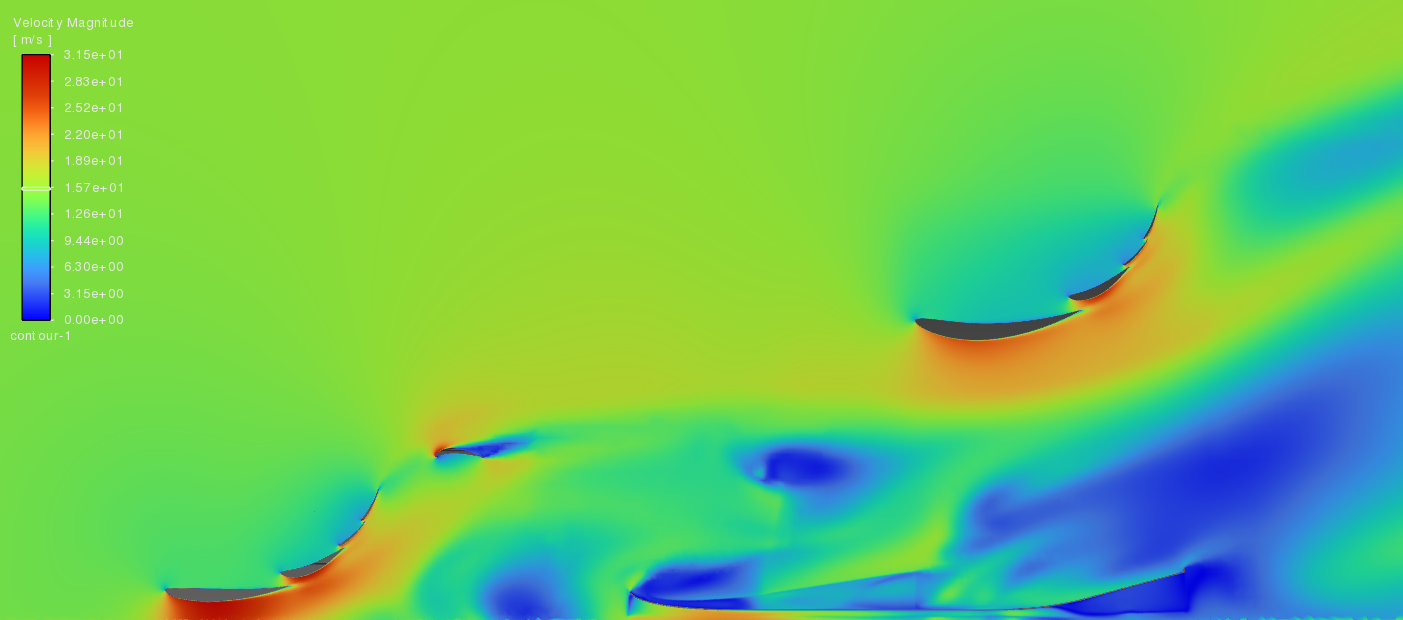
CT18 Inverted Wing
Formula SAE — Aerodynamics Subsystem
The CT18 car's front wing has upwash at a steep angle, which sends dirty air into the rear wing and cuts its downforce compared to what the rear wing does in isolation. This project designs an inverted wing/winglet that mounts behind the front wing to redirect that flow away from the rear wing and toward the side pods and radiator inlet instead.
I started by pulling numbers off the front wing sim to set the design target: exit velocity around 13 m/s, upwash angle near 62°, about 10% turbulence intensity. ParaView and CFD Post kept crashing trying to visualize that sim, even through UConn Anyware, so before doing any of the airfoil work I wrote a Python script that reads the Fluent HDF5 output directly. That let me actually see the dirty air coming off the front wing.
From there I ran 2D sweeps in OpenFOAM on five candidate airfoils: NACA 9411, two cambered plates, GOE 531, GOE 462/464, across 0 to 20 degrees AoA, testing 2% chord gurney flaps on a couple of them. NACA 9411 and the "#2" cambered plate section came out on top on L/D. GOE 531 dragged too much to bother with. The best result across all runs was the #2 airfoil with a gurney flap, hitting an L/D around 51.
With an airfoil chosen, I modeled the wing and its mount to the nose in SolidWorks, then ran the full car in ANSYS Fluent on the HPC cluster for 3D validation (mesh and case files ran over 2 GB). Once that sim finished, I pulled downforce and drag components straight from Ansys and checked how the wake off the inverted wing interacted with the rest of the car.